
Executive Summary
BYD has recently unveiled its second-generation Blade Battery and Flash Charging system, marking a significant advancement in electric vehicle (EV) technology. This launch is poised to reshape consumer expectations and operational frameworks within the EV market. The integrated approach of combining high-capacity charging infrastructure with advanced battery technology addresses critical pain points such as charging speed and battery safety. The stakes are high: as BYD positions itself as a leader in the EV sector, traditional internal combustion engine (ICE) vehicles face increasing pressure to adapt or risk obsolescence.
Key Insights
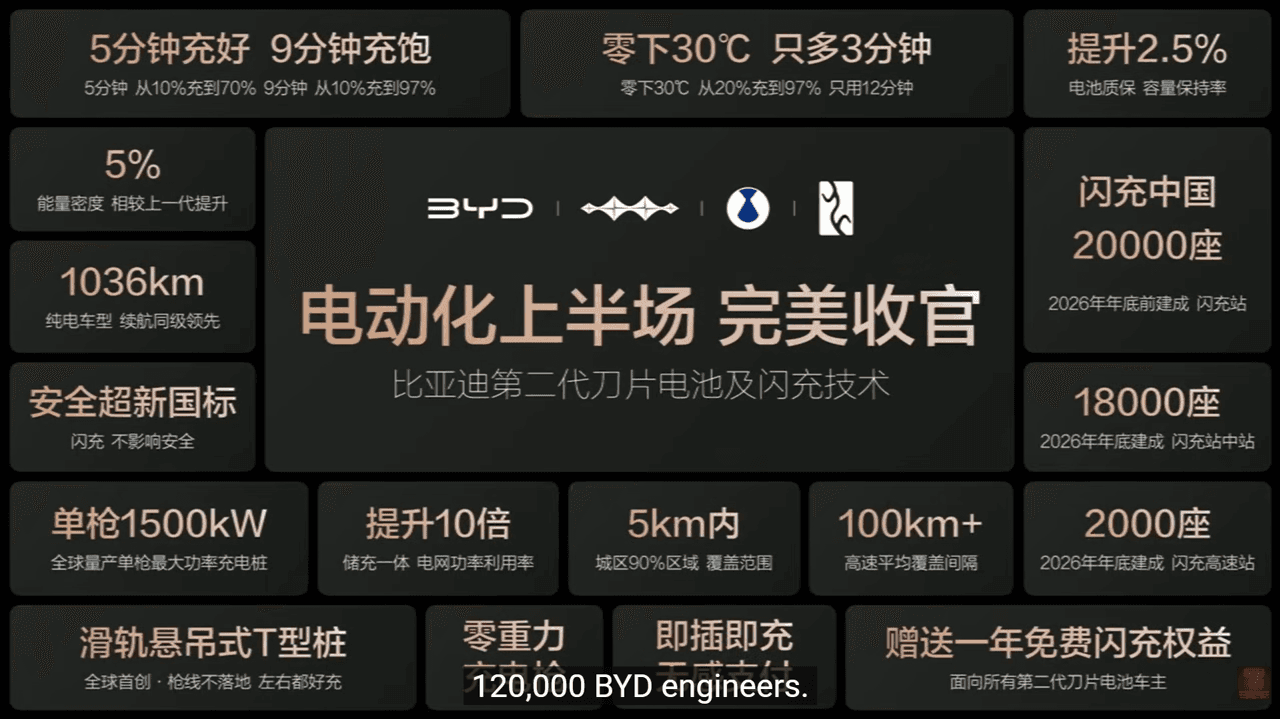
- BYD's new flash chargers can deliver over 1 MW of power, significantly reducing charging times—10-70% in just 5 minutes.
- Cold weather performance has improved, with charging capabilities up to 97% in under 12 minutes at -30°C.
- The Blade Battery boasts a 5% increase in energy density compared to its predecessor, enhancing overall vehicle efficiency.
- BYD plans to deploy 20,000 flash charging stations across China, with a focus on urban areas and highways.
- Charging payments are streamlined, allowing users to pay by simply plugging in, akin to Tesla's Supercharger system.
- BYD's commitment to safety includes rigorous testing beyond existing regulatory requirements, enhancing consumer confidence.
Strategic Implications
Industry Impact
BYD's advancements catalyze a potential shift in the EV industry, establishing new benchmarks for battery safety and charging speed. The integration of high-capacity charging systems with battery technology could set a new industry standard, compelling competitors to innovate or risk losing market share. As the market transitions towards faster and safer charging solutions, traditional charging infrastructure providers may face obsolescence unless they adapt to these new technologies.
Investor Perspective
For investors, BYD's technological leadership presents both opportunities and risks. The rollout of the Flash Charging system could enhance BYD's market share, positioning it as a frontrunner in the EV sector. However, the high initial costs associated with research and development, as well as the manufacturing of the new battery technology, could pose challenges. Investors should monitor the adoption rate of Flash Charging infrastructure, as a slow rollout could hinder BYD's growth trajectory.
Competitive Landscape
Competitors reliant on older battery technologies will likely feel the pressure to match BYD's advancements in safety and charging speed. The introduction of the Flash Charging system could lead to a competitive arms race in battery technology, compelling automakers to invest heavily in R&D to keep pace. Additionally, the potential for BYD to license its Blade Battery technology to other manufacturers could further disrupt the competitive landscape.
Policy Considerations
As BYD expands its charging infrastructure, regulatory frameworks surrounding EV charging technologies may need to evolve. Policymakers will have to consider the implications of widespread adoption of high-capacity charging systems, including grid stability and safety standards. The successful implementation of BYD's Flash Charging technology could influence future regulations and standards in the EV sector.
The Bottom Line
BYD's launch of the second-generation Blade Battery and Flash Charging system signifies a structural shift in the electric vehicle market. By addressing critical consumer concerns related to charging speed and battery safety, BYD is not only enhancing its competitive positioning but also redefining the future of electric mobility. As the industry adapts to these advancements, the viability of internal combustion engine vehicles may increasingly come into question, highlighting the urgency for traditional automakers to innovate.
FAQs
- What is the significance of BYD's Flash Charging technology? BYD's Flash Charging technology significantly reduces EV charging times, enhancing convenience and addressing consumer anxiety regarding charging infrastructure.
- How does BYD's Blade Battery compare to traditional batteries? The Blade Battery offers improved energy density and safety features, making it a competitive alternative to traditional battery technologies.
- What are the potential risks for BYD's competitors? Competitors may face obsolescence if they cannot match BYD's advancements in battery safety and charging speed, potentially losing market share.
Source: CleanTechnica
 Spotify
 Apple
Apple Amazon
 YouTube