
The End of Legacy Fuels
The maritime fuels landscape is undergoing a seismic shift as the world moves towards decarbonization. The end of reliance on traditional fossil fuels is imminent, driven by stringent carbon pricing and the electrification of road transport. This transition is not merely a trend; it is a necessity dictated by economic realities and regulatory pressures.
The Rise of Electrification
As we approach 2030, electrification is set to become the dominant force in maritime fuel economics. Current analysis indicates that electricity, even at prevailing industrial rates, is already more cost-effective than very low sulfur fuel oil (VLSFO) under various carbon pricing scenarios. With electricity delivering up to 95% of its energy to the crankshaft, compared to 45-50% for VLSFO, the economic advantages are clear.
Carbon Pricing: A Double-Edged Sword
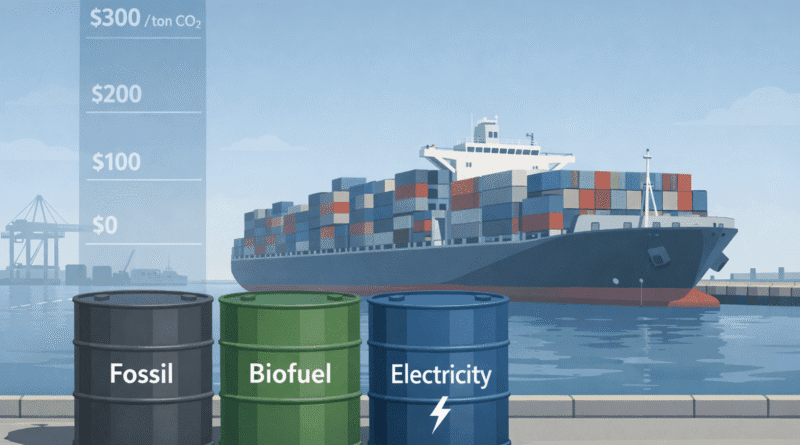
Carbon pricing is reshaping the cost structure of maritime fuels. At a projected carbon price of $200 per ton of CO2, the effective price of VLSFO could soar to $1,273 per crank equivalent. This economic pressure will force shipping operators to reconsider their fuel strategies, as fossil fuels become increasingly untenable in a decarbonizing world.
Biofuels: Compliance Fuels, Not Cost Leaders
Biofuels are positioned as compliance fuels rather than economical alternatives in this new era. While they may approach parity with fossil fuels at higher carbon prices, their reliance on finite biological feedstocks constrains their scalability. The competition for low-carbon biomass will further tighten supply and drive prices upward, making biofuels less attractive unless supported by strong regulatory frameworks.
The 2030 Outlook for Maritime Fuels
By 2030, the maritime fuel system will be defined by crank equivalent costs, carbon pricing, and emissions control areas (ECAs). As shipping demand shifts predominantly to aviation and maritime sectors, the refining system will shrink, leading to higher fixed costs per barrel. This dynamic will further elevate the price of residual fuels, making electrification the most viable option for many vessels operating in predictable routes and high ECA zones.
Strategic Recommendations for Maritime Operators
For maritime operators, the data suggests a clear path forward. Electrify where feasible, invest in hybrid technologies, and prepare for a future where fossil fuels are a diminishing resource. The transition will not only reduce operational costs but also align with global decarbonization goals.
Conclusion: Aligning with the Future
The trajectory of maritime fuels is set towards a future dominated by electrification and stringent carbon regulations. Operators and policymakers must adapt to these changes or risk being left behind in an industry that is rapidly evolving.
FAQ
The primary driver is the accelerating global decarbonization trend, enforced by increasingly stringent carbon pricing mechanisms and the economic unviability of traditional fossil fuels compared to emerging alternatives like electrification.
Electrification is projected to be significantly more cost-effective. Even at current industrial rates, electricity offers a higher energy conversion efficiency (up to 95% to the crankshaft) compared to VLSFO (45-50%), making it the leading economic choice, especially when factoring in rising carbon prices.
Carbon pricing is expected to dramatically increase the effective cost of legacy fuels. A projected carbon price of $200 per ton of CO2 could raise the cost of VLSFO to over $1,273 per crank equivalent, rendering it economically unsustainable for many operations.
Biofuels are expected to serve primarily as 'compliance fuels' rather than cost-leading alternatives. Their scalability is limited by finite feedstocks, and competition for these resources will likely drive up prices, making them less attractive economically unless strongly supported by regulatory mandates.
Maritime operators should prioritize electrification for feasible routes, invest in hybrid technologies, and strategically plan for the diminishing availability and increasing cost of fossil fuels. This proactive approach will reduce operational expenses and ensure alignment with global decarbonization goals.