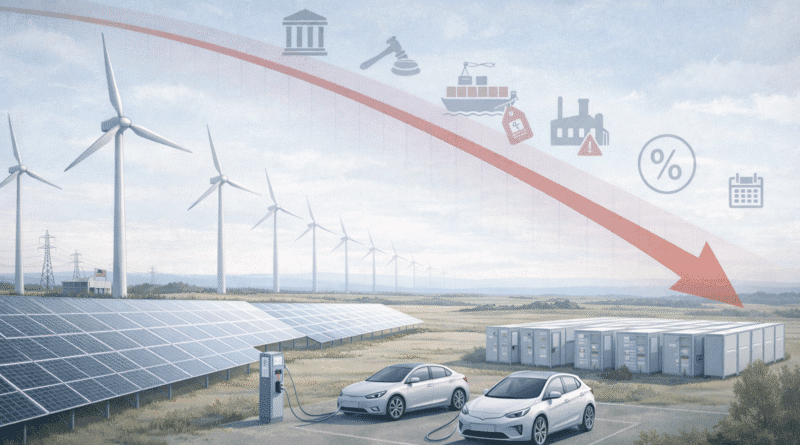

Why Everyone is Wrong About Tariff Stability
Tariff instability in the U.S. is not just a nuisance; it’s a ticking time bomb for clean technology investment. The recent Supreme Court ruling, which ostensibly limits presidential tariff authority, has failed to eliminate uncertainty. Instead, it has merely shifted the risk landscape, creating a new layer of complexity for capital-intensive clean energy projects.
The Uncomfortable Truth About Clean Technology Financing
Clean technology deployment is inherently vulnerable to tariff volatility. Unlike software, which can pivot on a dime, clean energy infrastructure relies on a web of physical materials—steel, lithium, copper—all of which are susceptible to price fluctuations driven by tariffs. The average cost of a 200 MW solar project ranges from $300 million to $500 million. When tariff uncertainty enters the equation, it directly impacts the weighted average cost of capital (WACC), which is crucial for financing these long-term assets.
Stop Doing This: Underestimating the Cost of Capital
Many stakeholders in the clean energy sector are underestimating how tariff volatility affects the cost of capital. A mere 75 basis point increase in WACC can elevate the levelized cost of energy (LCOE) by $2 to $4 per MWh. In competitive bidding environments, where the margin for winning bids can be razor-thin, this is not just a minor inconvenience; it’s a death knell for marginal projects that can’t afford the higher costs.
How Tariff Volatility is a Silent Killer
Tariff instability creates a cascading effect that compounds existing bottlenecks in the supply chain. Procurement contracts become fraught with uncertainty, and lenders tighten their terms. As developers add contingencies to their budgets, the overall cost of projects spirals. This is not a hypothetical scenario; it’s happening now. The market is pricing in not just current tariffs but also the looming threat of new tariffs under different legal frameworks.
The Myth of Domestic Manufacturing Resilience
Many proponents argue that tariffs will bolster domestic manufacturing. This is a dangerous misconception. The reality is that domestic clean technology manufacturing is not insulated from global supply chains. A battery plant, for instance, still relies on imported materials. If tariffs inflate input costs, the very domestic manufacturing they aim to protect becomes less competitive, further complicating the investment landscape.
The Cost of Inaction: A Call to Arms for Investors
Investors need to wake up to the reality that tariff volatility is not just a legal issue; it’s a financial one. A 5% increase in construction costs for a $3 billion gigafactory due to tariff volatility could translate to a $150 million hit to the bottom line. If WACC rises from 8% to 9%, the net present value could plummet by hundreds of millions over two decades. This is not just a theoretical exercise; for many firms, it could mean the difference between moving forward with a project or scrapping it altogether.
Why the Future of Clean Technology is at Stake
While the macroeconomic picture for clean energy remains somewhat stable, the headwinds created by tariff volatility cannot be ignored. If annual solar deployment drops by just 5% due to these pressures, that translates to a loss of 7.5 GW over five years. The cumulative impact of these small annual drags is significant. The paradox is stark: tariffs intended to protect domestic industries could very well end up crippling them under conditions of instability.
The Path Forward: Demand Predictability
For clean technology to thrive, we need a stable industrial policy that provides predictability. The Supreme Court ruling is a legal event, but the market’s response hinges on how trade policy evolves. If we can establish clear boundaries around tariff authority, with refund clarity and multi-year visibility, capital will adapt accordingly. Otherwise, we’re left with a landscape of uncertainty that will only increase the cost of capital and slow down the necessary energy transition.
FAQ
Tariff instability directly increases the Weighted Average Cost of Capital (WACC) for clean energy projects, which are heavily reliant on physical materials like steel and lithium. Even a small increase in WACC can significantly raise the Levelized Cost of Energy (LCOE), making projects less competitive and potentially unviable, especially in tight bidding environments.
The belief that tariffs will automatically strengthen domestic manufacturing is flawed. Many domestic clean tech operations still depend on imported raw materials. Tariffs can inflate these input costs, making the protected domestic industries less competitive globally and complicating investment decisions.
Tariff volatility can lead to substantial financial hits. For instance, a 5% increase in construction costs for a gigafactory could mean a $150 million loss. A rise in WACC from 8% to 9% can reduce net present value by hundreds of millions over two decades, potentially leading to projects being abandoned.
The clean technology sector requires a stable industrial policy that offers predictability in trade and tariff regulations. Clear boundaries around tariff authority, refund clarity, and multi-year visibility are essential for capital markets to adapt and for the necessary energy transition to accelerate.